
A Sapa Paragliding Flight in Numbers
Take-off at 1,500 m, landing near 1,000 m, a glide of 8 to 1, 8 to 15 minutes in the air and a 40 m2 wing — every number behind a tandem flight in Sapa, explained

Pilots talk to each other in numbers: how high, how fast you sink, how far you glide. Passengers usually only know the price and the figure 1,500 m. This article takes a tandem flight in Sapa apart number by number, and explains what each one actually means for the flight you are booking
Shared by Dang Van My — Vietnamese paragliding pilot, chief pilot at Sapa Paragliding
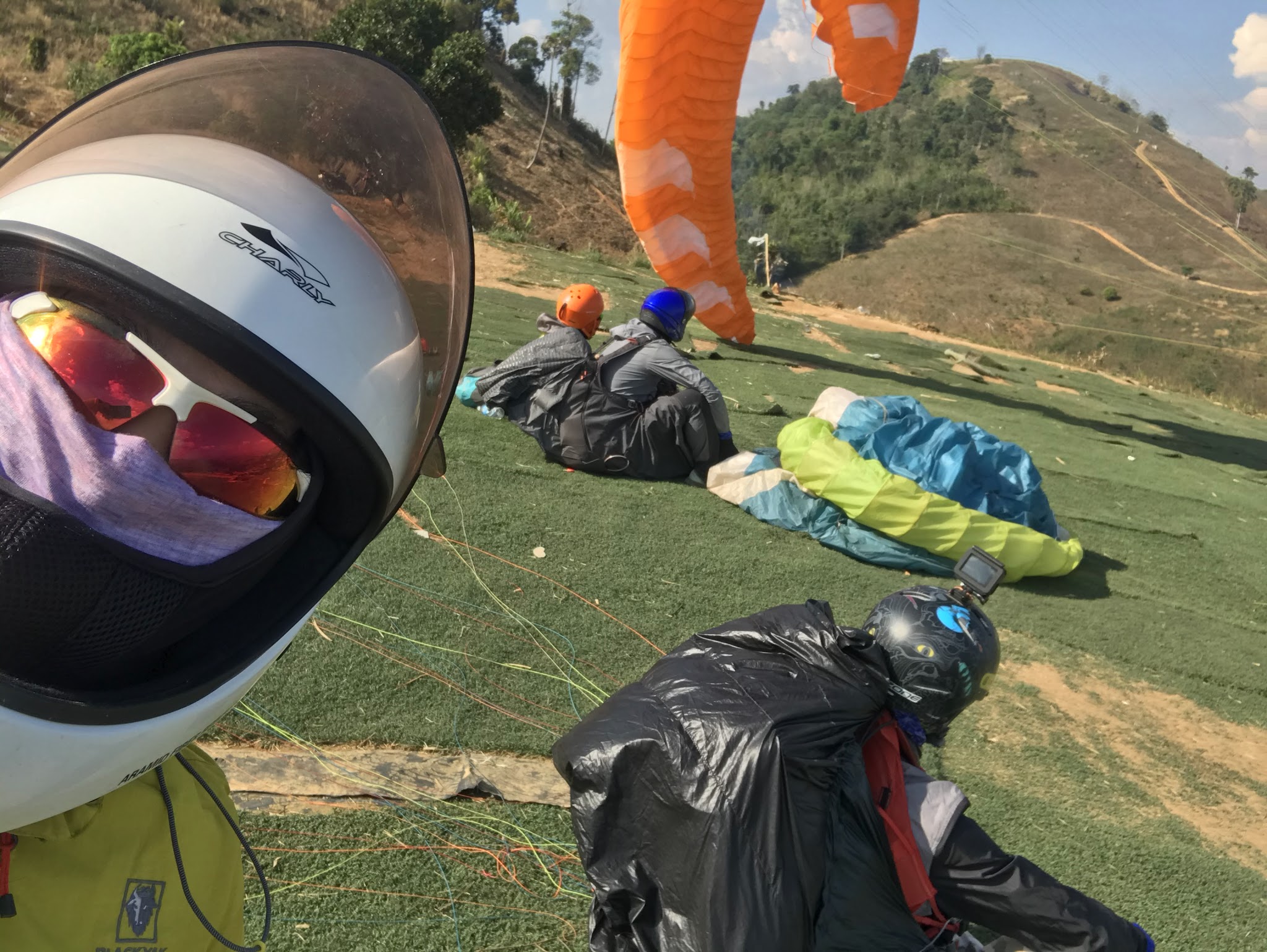
⛰ 1,500 m and 1,000 m — the two numbers that shape the flight
The Hang Da take-off sits at about 1,500 m above sea level. The landing field at Lao Chai village, down on the floor of Muong Hoa Valley, sits at around 1,000 m. The difference between the two ends is roughly 500 m
Those 500 m are the whole budget for the flight. A paraglider has no engine, it only ever descends relative to the air around it. The pilot spends that 500 m to buy distance and time in the air. More vertical drop means a longer flight, which is why a good flying site starts with the terrain
🪂 A glide ratio of 8:1 — the number that sets how far you go
A tandem wing glides at roughly 8 to 1. In still air, for every metre it sinks it travels about 8 metres forward
Multiply 500 m of height by 8 and you get about 4 km of flight path if you fly straight from take-off to landing. In practice the pilot does not fly straight, he turns to show you the valley and to work the rising air, so real flights usually cover 4 to 7 km
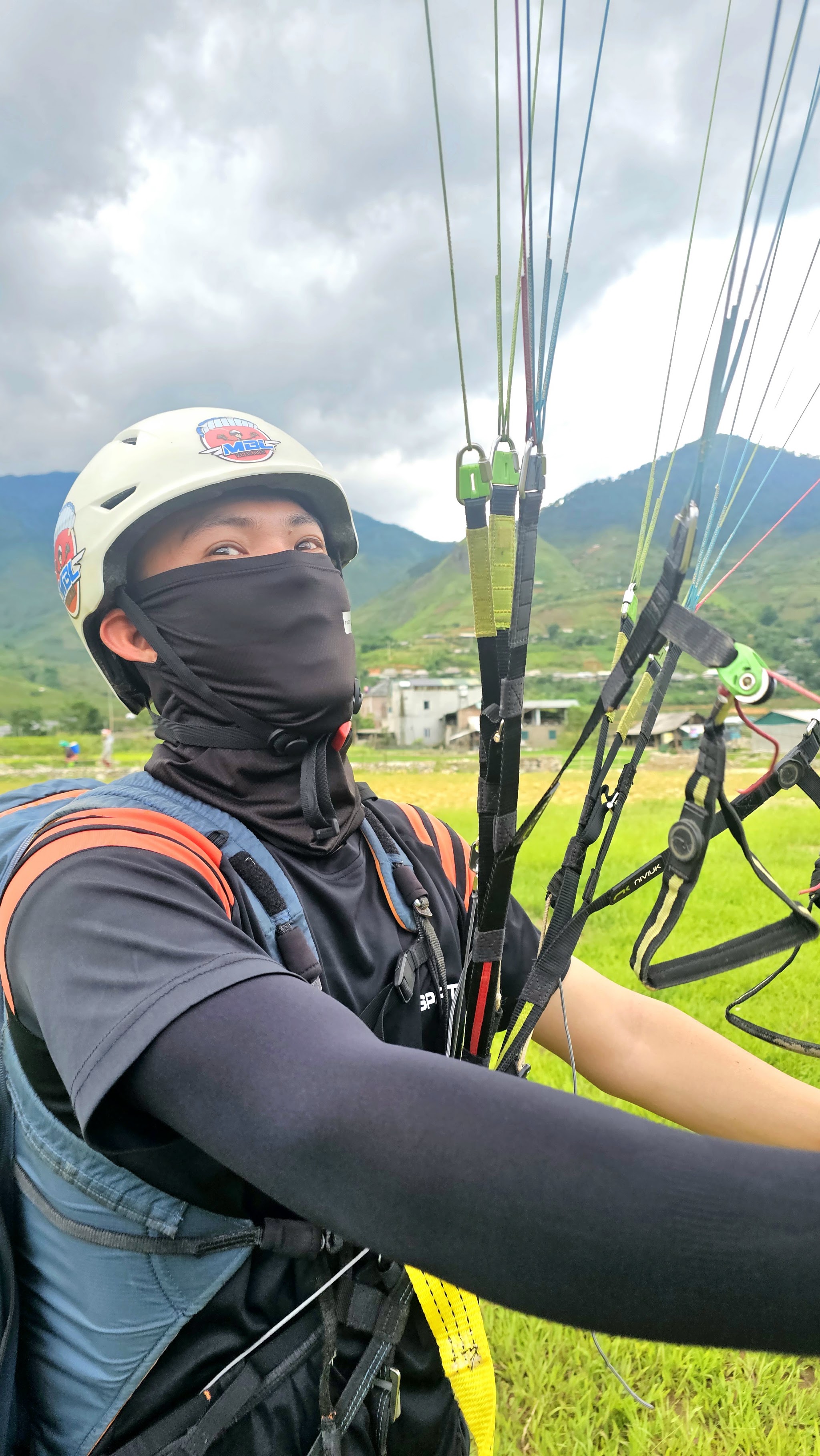
⏱ 8 to 15 minutes in the air, 90 minutes end to end
In still air a tandem wing sinks about 1.2 to 1.5 metres per second. Divide 500 m by 1.3 m/s and you get roughly six and a half minutes. That is the shortest a flight can physically be, on a day with nothing lifting
In practice we fly 8 to 15 minutes, because there is almost always rising air along the route to offset the sink. On a good sunny day with strong thermals a pilot can stretch it further
The 90 minutes is the end-to-end figure, from pick-up to drop-off: 15 minutes by car up to Hang Da, the safety briefing and harness fitting, waiting for the right wind, the flight itself, then the car meeting you at the Lao Chai landing field
💨 35–40 km/h and two wind limits worth knowing
A tandem wing flies at about 35 to 40 km/h through the air. That sounds slow, but you are sitting in the open, so the airflow on your face feels considerably faster than the number suggests
The part people misread: 35 km/h is speed through the air, not over the ground. Into a 20 km/h headwind the wing looks almost parked from below, moving over the ground at only 15 to 20 km/h. With the wind behind, the opposite
The two wind limits we fly by
- Wind at the take-off from the north, north-east, east or west stronger than 6 m/s: no flying
- Wind about 500 m above take-off blowing from the west, east or north at more than 12 m/s: no flying, even if the hill feels calm
- Fog or low cloud on the take-off: we wait for it to clear, usually between 9 and 11am
- Rain: no flying, because wet fabric gets heavy and loses its shape
⚖️ 100 kg, ages 3 to 70, and 20 kg on the pilot's back
We take passengers up to 100 kg. That limit is not arbitrary, it comes from the maximum flying weight the wing is certified for: pilot plus passenger plus equipment, and it cannot be exceeded
The age range we fly is 3 to 70. Passengers under 18 need a parent or guardian present and consenting. These numbers are applied, not decoration
The part nobody notices: the pilot carries about 20 kg up the hill every flight. The tandem wing is 8 to 9 kg, the two harnesses together 6 to 7 kg, the reserve about 3 kg, before the helmet and radio. Several laps of that a day is simply the job
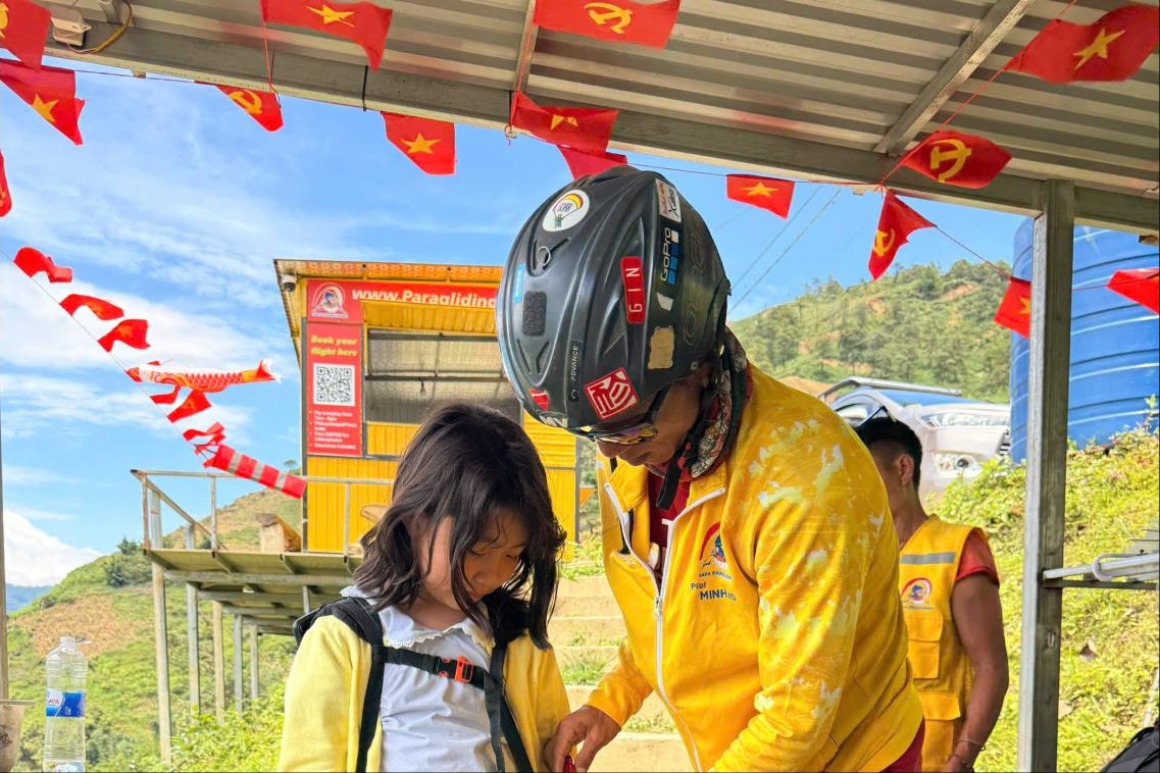
🧵 About 40 m² of fabric, certified to hold 8 times the load
A tandem wing has a surface area of roughly 38 to 42 square metres, about the floor of a small apartment. All of that fabric connects to the two of you through a few dozen lines no thicker than fishing line
Thin as they look, the European standard EN 926-1 requires the wing to withstand 8 times its maximum flying weight without failing before it can be certified. The lines and fabric are built with a very large margin over anything normal flight puts through them
The reserve parachute is opened, inspected and repacked every six months, with the date written on the harness
🌡 About 3°C colder up there than on the ground
Air cools with height, roughly 0.6°C for every 100 m. The 500 m between take-off and landing means it is about 3°C colder up top than down in the valley
Add 35 to 40 km/h of airflow on your face and hands and it feels colder than that. In winter bring a jacket that closes at the neck and thin gloves, in summer long sleeves are enough
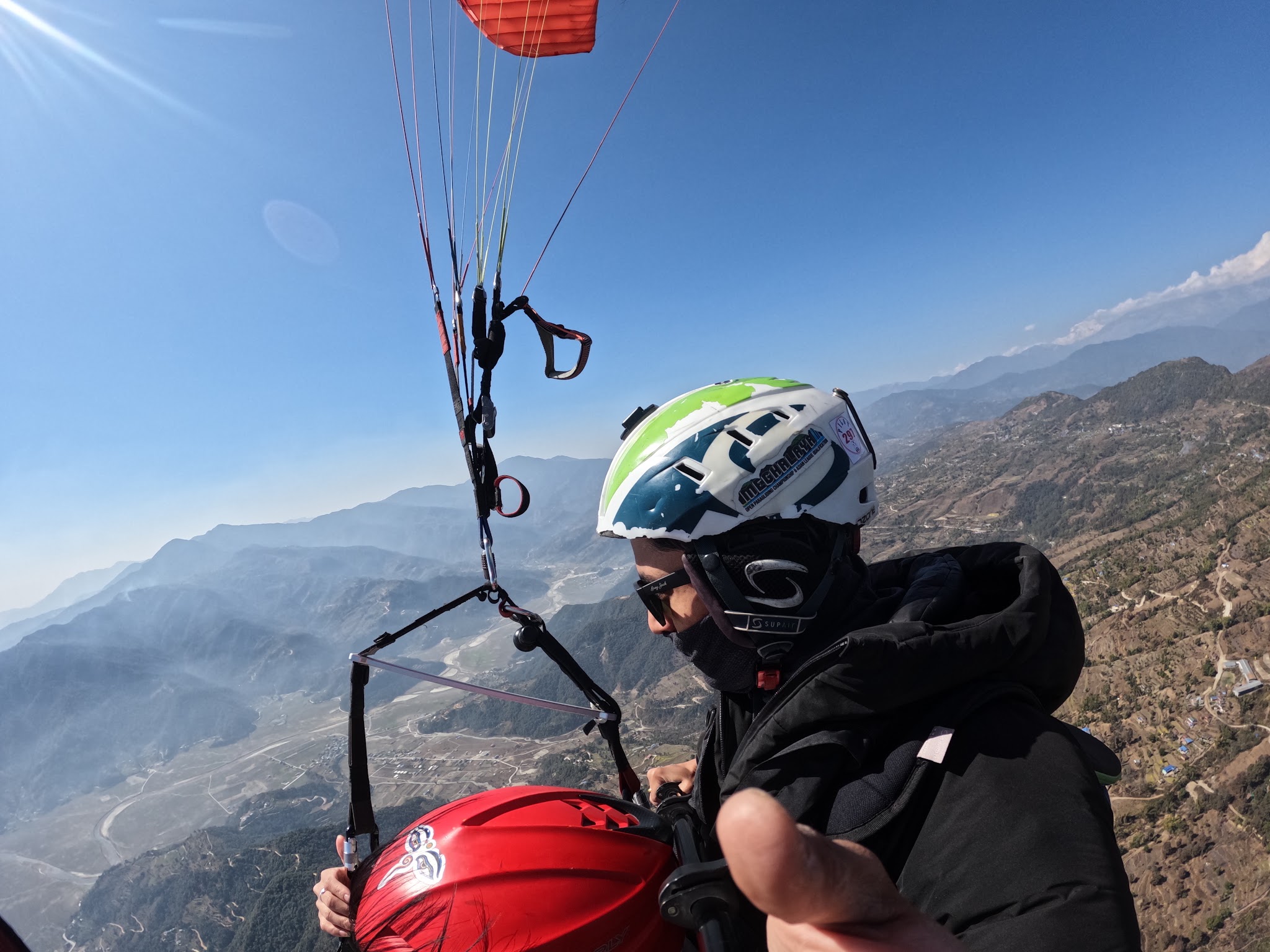
❓ What passengers ask about these numbers
Does 1,500 m mean I am 1,500 m above the ground? No. 1,500 m is the height of the take-off above sea level. The actual gap between you and the ground below is around 500 m at launch, shrinking as you approach the landing field
What if I weigh more than 100 kg? We cannot take you above that, because it is a technical limit of the wing rather than a house rule. Tell us your weight in advance so we can match the pilot and the wing
Is 8 minutes too short? Eight minutes is the low end, on a still day. Most flights land in the 10 to 15 minute range, and the time in the air feels nothing like the time on a clock
What does it cost? We run three packages, starting at 2,090,000 VND for a tandem flight, equipment and insurance included
🚀 Flying with Sapa Paragliding
Sapa Paragliding was the first operator flying paragliders in Sapa, trading as CTCP Thể thao và Du lịch Dù lượn Sa Pa, with flight permission 17996/TC-QC from the Department of Operations under the General Staff, Ministry of National Defence, and paragliding business licence 02/GCN-SVHTT from the Lao Cai Department of Culture and Sports
About the author — Dang Van My, Vietnamese paragliding pilot and chief pilot at Sapa Paragliding. He surveyed the flying terrain around Sapa himself and opened the first paragliding site here